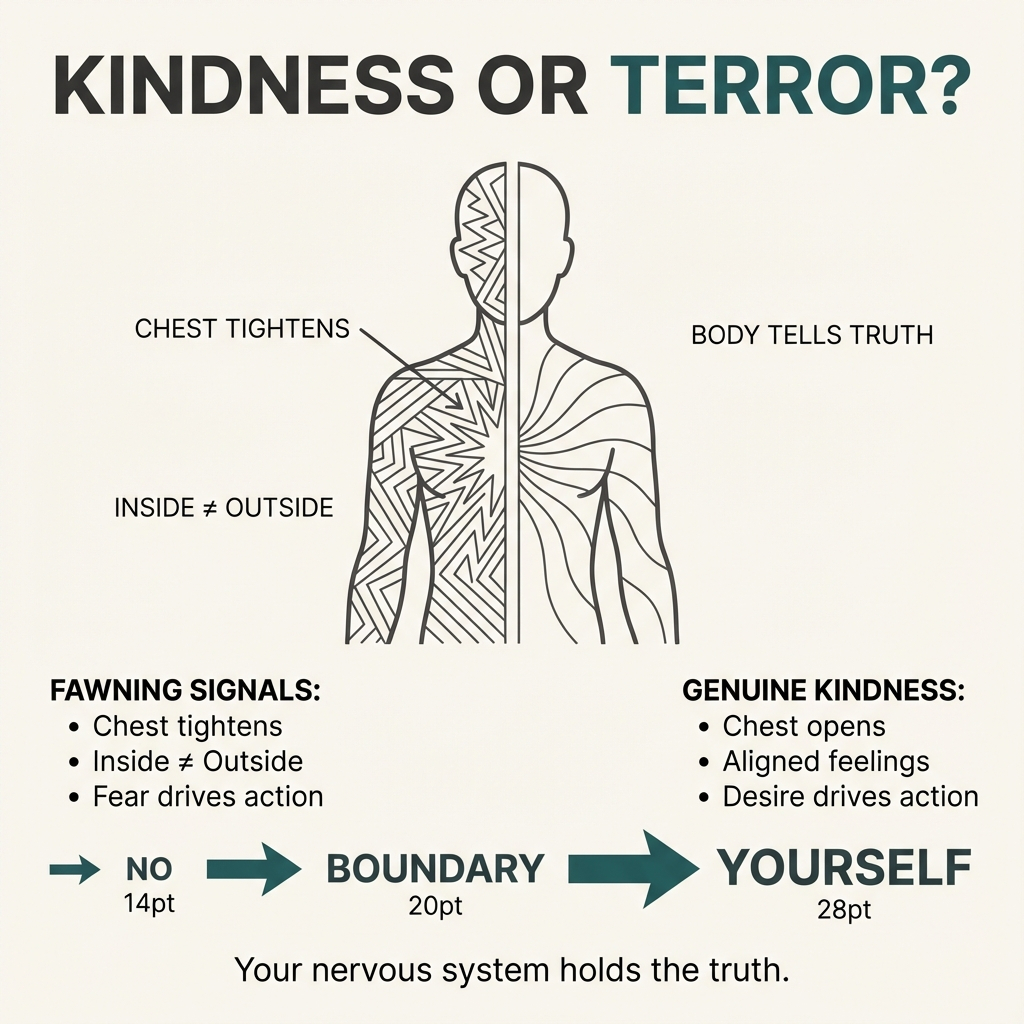
TL;DR: Fawning feels like kindness but comes from fear, not genuine desire. Your body knows the difference. Kindness feels open and aligned. Fawning feels tight and disconnected. This guide shows you how to read your body's signals, practice boundaries without guilt, and reconnect with what you really want after years of people-pleasing.
What You Need to Know Right Now
Kindness matches inside and outside. You want to help, you have capacity, helping feels good.
Fawning splits you in two. You smile while feeling resentful, numb, or afraid.
Your body signals the truth through chest tightness, throat lumps, numbness, or breath-holding.
Start with small nos like "That doesn't work for me" or "I need to check my calendar first."
Reconnect by asking "What do I need?" instead of "What do they need?"
I spent decades thinking I was kind.
Turns out, I was just terrified.
The difference between genuine kindness and fawning lives in your body. Your nervous system knows the truth even when your mind tells you otherwise. I learned to read these signals after years of performing kindness while my insides screamed.
Here's how to recognize when you're fawning, how to practice saying no without turning into someone you're not, and the specific steps for reconnecting with your own wants after prioritizing everyone else for so long.
What Is the Fawn Response?
The fawn response is a survival strategy where you become more appealing to a threat instead of fighting, fleeing, or freezing. You abandon your needs to manage someone else's emotional state.
Licensed psychotherapist Pete Walker coined this term in his book Complex PTSD: From Surviving to Thriving. He describes fawning as seeking safety by merging with the wishes, needs, and demands of others.
This pattern protects you as a child. When expressing anger or having needs brings neglect or abuse, you learn to take care of the parent instead. You read their emotional state. You manage their feelings. You disappear yourself to stay safe.
The survival strategy becomes the prison.
Bottom line: Fawning kept you safe once. Now you're performing kindness while abandoning yourself.
How Your Body Knows You're Fawning
Your body knows before your brain catches up.
When I'm genuinely kind, my chest feels open. My breathing stays steady. What I feel inside matches what I show outside.
When I'm fawning, everything tightens.
Physical Signals of Fawning
Tightness in your chest or stomach
A lump in your throat
Sweating or shaking
Feeling numb or "checked out"
Chronic pain, headaches, or digestive issues
Disconnection from reality (dissociation)
I watch what happens in my body when someone seems upset. Does my chest constrict? Does my stomach drop? Do I hold my breath?
These physical responses tell the truth your mind wants to deny.
You disconnect from your body's sensations when fawning. You go numb. You cut yourself off from your own needs because tuning into them feels dangerous.
The point: Your body speaks in sensations. Learn to listen.
How to Distinguish Kindness From Fawning
The clearest way to tell the difference? Check whether your inside matches your outside.
Genuine Kindness Looks Like This
Your internal feelings align with your external actions
You want to help
You have capacity to help
Helping feels good
You don't need recognition or keep score
You don't feel resentful later
Fawning Looks Like This
Your inside and outside split apart
You smile while feeling resentful, overwhelmed, angry, numb, or disconnected
You help because you're afraid of what happens if you don't
You need validation for your sacrifice
You keep mental tallies of what you give
You feel drained and resentful afterward
Kindness comes from genuine desire. Fawning comes from fear.
I ask myself: Am I doing this because I want to, or because I'm terrified of what happens if I don't?
The answer shows up in my body before my thoughts catch up.
What this means for you: Stop asking if you're being nice enough. Start asking if your insides match your outsides.
Why Fawning Gets Mistaken for Kindness
Fawning gets rewarded.
People who fawn appear helpful, accommodating, and selfless. We get praised for being "so nice" and "so generous." The external validation feels good, even when we're dying inside.
You act as though the price of entry to any relationship is abandoning all your needs, rights, preferences, and boundaries. You believe love costs your entire self.
Here's the trap: Everyone loves the version of you who says yes. They reward you for disappearing. They get uncomfortable when you start showing up as yourself.
So you keep performing. You keep fawning. You confuse the applause for connection.
Reality check: You're not being loved. You're being used. There's a difference.
How to Practice Small Nos Without Turning Into Someone You're Not
You don't need to become mean to stop fawning.
You need to practice small nos.
Setting boundaries is a skill. Start small. Build tolerance for the discomfort. Watch as the catastrophe you feared doesn't show up.
Start With These Small Nos
Notice I didn't include explanations or justifications. You don't owe anyone a dissertation on why you're declining.
You're not being difficult. You're being clear.
Questions to Ask Before You Say Yes
When you suspect you're fawning, pause. Ask yourself:
Am I saying yes to please someone else?
Is this costing me something I don't have to give?
Do my actions right now align with my values?
What to Do With the Guilt
The guilt you feel when setting boundaries has a name: unwarranted guilt.
The guilt comes from anticipating the other person's reaction. You picture their disappointment or anger. Your nervous system responds to the imagined threat as though it's real.
Here's what helps: The more you set boundaries, the less guilty you feel about setting them.
Your nervous system learns that saying no doesn't end in catastrophe. You teach yourself through repetition.
Permission granted: You don't need anyone's approval to choose yourself.
How to Set Boundaries Without Becoming Someone You Hate
Boundaries protect relationships, not destroy them.
When you set clear boundaries, you show up more authentically. You stop building resentment. You create space for genuine connection instead of performing connection.
Boundaries benefit you and the people around you. Avoiding boundaries to prevent guilt creates bigger problems later.
Being clear isn't being difficult.
What Boundaries Sound Like
"I'll help with X, but not Y"
"I'm available Tuesday, not Wednesday"
"I need advance notice for requests like this"
"I'll give you 20 minutes, not an hour"
Notice the structure: state what you'll do, then state what you won't. Or state your limit clearly and stop talking.
You're not being mean. You're being honest.
Here's the truth: People who respect you will respect your boundaries. People who don't respect your boundaries don't respect you.
How to Reconnect With Your Own Needs
After decades of prioritizing everyone else, you might not know what you want anymore.
I had to relearn how to hear my own voice.
Start by listening to your body. Your body holds wisdom your mind has learned to ignore.
Body-Based Reconnection Practices
Notice physical sensations without judging them
Ask yourself: "What does my body want me to know?"
Pay attention to what makes you feel energized versus drained
Track when you feel most like yourself
Notice what you do when no one's watching
The fawn response makes your own truth hard to hear. You've spent so long tuning into everyone else's frequency. Your own signal feels faint.
The Critical Question Shift
I practice shifting from "What do they need?" to "What do I need?"
This shift feels uncomfortable at first. Your nervous system reads self-focus as dangerous. You might feel selfish or guilty for considering your own needs.
That discomfort is information, not instruction. Feel it. Do the thing anyway.
What you need to know: Tuning into yourself after years of tuning into others takes practice. Your own voice will get louder the more you listen.
Why You Have to Be Kind to Yourself First
You can't practice genuine kindness toward others while abandoning yourself.
Real kindness requires balancing your needs with the needs of others. Not sacrificing your needs to meet theirs.
When you consistently prioritize others at your own expense, you end up exhausted, resentful, and disconnected from yourself. You might look generous on the outside, but you're running on fumes.
Kindness to Yourself Looks Like This
Honoring your physical needs (rest, food, movement)
Protecting your time and energy
Saying no without guilt
Asking for what you want
Allowing yourself to change your mind
Choosing discomfort over resentment
I had to learn that taking care of myself wasn't selfish. Taking care of myself was required.
You secure your own oxygen mask first. Not because you matter more, but because if you pass out, you're useless to everyone.
The shift: From performing for others to taking care of yourself so you have something real to give.
Daily Practice: Tuning Into Yourself
Reconnecting with your needs takes consistent practice.
I use simple check-ins throughout the day:
Morning: What do I really want today? (Not what I should want. What I really want.)
Midday: How does my body feel right now? What does it need?
Evening: When did I feel most like myself today? When did I feel most disconnected?
These questions help me stay connected to my internal experience instead of constantly scanning the environment for what others need from me.
Obligation vs. Desire
I practice noticing the difference:
Obligation feels heavy, constrictive, draining
Desire feels light, expansive, energizing
Sometimes I need to do things I don't desire. That's part of being an adult. But when everything feels like obligation and nothing feels like desire, I know I've lost connection with myself.
Key insight: Your body knows the difference between obligation and desire. Pay attention to how each one feels.
What Genuine Kindness Looks Like
Genuine kindness comes from overflow, not depletion.
When I'm truly kind, I give from a full cup. I have capacity. I want to help. My internal state matches my external actions.
I don't need recognition or validation. I don't feel resentful later. I don't keep score.
Real Kindness Includes
Helping when you have capacity
Declining when you don't
Being honest about your limitations
Offering what you have without resentment
Respecting both your needs and others' needs
The goal isn't to stop being kind. The goal is to stop abandoning yourself in the name of kindness.
Remember: Kindness without self-respect is performance. Kindness with boundaries is freedom.
Frequently Asked Questions
How long does it take to stop fawning?
There's no fixed timeline. You're rewiring decades of conditioning. Some people notice shifts in weeks. Others take months or years. Progress isn't linear. You'll have days where boundaries feel easy and days where saying no feels impossible. Keep practicing.
Will people get mad when I start setting boundaries?
Some will. The people who benefited from your lack of boundaries might push back. They liked the version of you who always said yes. Their discomfort with your boundaries tells you everything you need to know about the relationship.
How do I know if I'm being selfish or setting healthy boundaries?
Selfishness disregards others' needs entirely. Healthy boundaries balance your needs with others' needs. If you're asking this question, you're not being selfish. Selfish people don't worry about being selfish.
What if I feel guilty every time I say no?
Guilt is normal when you start setting boundaries. Your nervous system learned that saying no brings danger. The guilt will decrease as you practice. Each time you set a boundary without catastrophe, you teach your nervous system that you're safe.
Do I need boundaries to be kind?
Yes. You need boundaries to practice genuine kindness. Without boundaries, you're performing kindness while building resentment. Real kindness comes from a full cup, not an empty one.
What if I've been fawning my whole life and don't know who I am?
Start with your body. Your body knows who you are even when your mind doesn't. Notice what makes you feel energized versus drained. Pay attention to what you do when no one's watching. Your authentic self will emerge as you practice tuning in.
How do I explain my new boundaries to people who are used to the old me?
You don't owe explanations. "That doesn't work for me" is a complete sentence. If you want to explain, keep it simple: "I'm working on being more honest about my capacity." People who respect you will adjust.
What's the difference between fawning and being a good person?
Good people have boundaries. Good people say no. Good people prioritize their needs sometimes. Fawning makes you appear good while destroying you from the inside. Being good means being honest, not being limitless.
Key Takeaways
Your body knows the difference between kindness and fawning. Kindness feels open and aligned. Fawning feels tight and split.
Fawning is a survival response where you abandon your needs to manage someone else's emotional state. It protected you once but now it's your prison.
Check if your inside matches your outside. Kindness aligns. Fawning creates a split between what you feel and what you show.
Start with small nos. "That doesn't work for me" is a complete sentence. You don't owe explanations.
The guilt you feel when setting boundaries is unwarranted guilt. It decreases with practice as your nervous system learns you're safe.
Shift from "What do they need?" to "What do I need?" This feels uncomfortable at first because your nervous system reads self-focus as dangerous.
You need to be kind to yourself first. Not because you matter more, but because you're useless to everyone when you're running on fumes.
Learning to distinguish kindness from fawning takes time.
You're rewiring decades of conditioning. Your nervous system learned to prioritize others' needs as a survival strategy. Changing the pattern requires patience and practice.
Start with body awareness. Notice the physical sensations with fawning versus genuine kindness. Let your body teach you the difference.
Practice small nos. Build your tolerance for the discomfort with setting boundaries. Watch as the catastrophe you feared doesn't show up.
Reconnect with your own needs. Ask yourself what you want, not what you should want. Listen to your body's wisdom.
Be kind to yourself in the process. You're learning a new language after speaking the old one your entire life.
The difference between kindness and fawning lives in your body, shows up in your motivation, and reveals itself in whether your inside matches your outside.
You can be kind without abandoning yourself.
That's not a fantasy. That's the whole point.


Comments
Post a Comment
We appreciate your comments!