TL;DR: Research shows abused children are 3x more likely to repeat patterns, but awareness breaks the cycle. This guide covers how to move from fawn survival mode to self-advocacy through five specific steps, practice boundaries without becoming someone you don't recognize, and why asking "What do I want?" is revolutionary. Your intention to break the cycle is already a gift to yourself and everyone you love.
The Core Steps to Breaking the Fawn Pattern:
Name your fawn response in real time (awareness is the first breakthrough)
Practice small nos in low-stakes situations (boundaries are a skill you build)
Reconnect with your body's signals (your sensations are data, not noise)
Build support with trauma-informed people (you're a transitional character, changing your lineage)
Redefine safety as honoring yourself, not erasing yourself
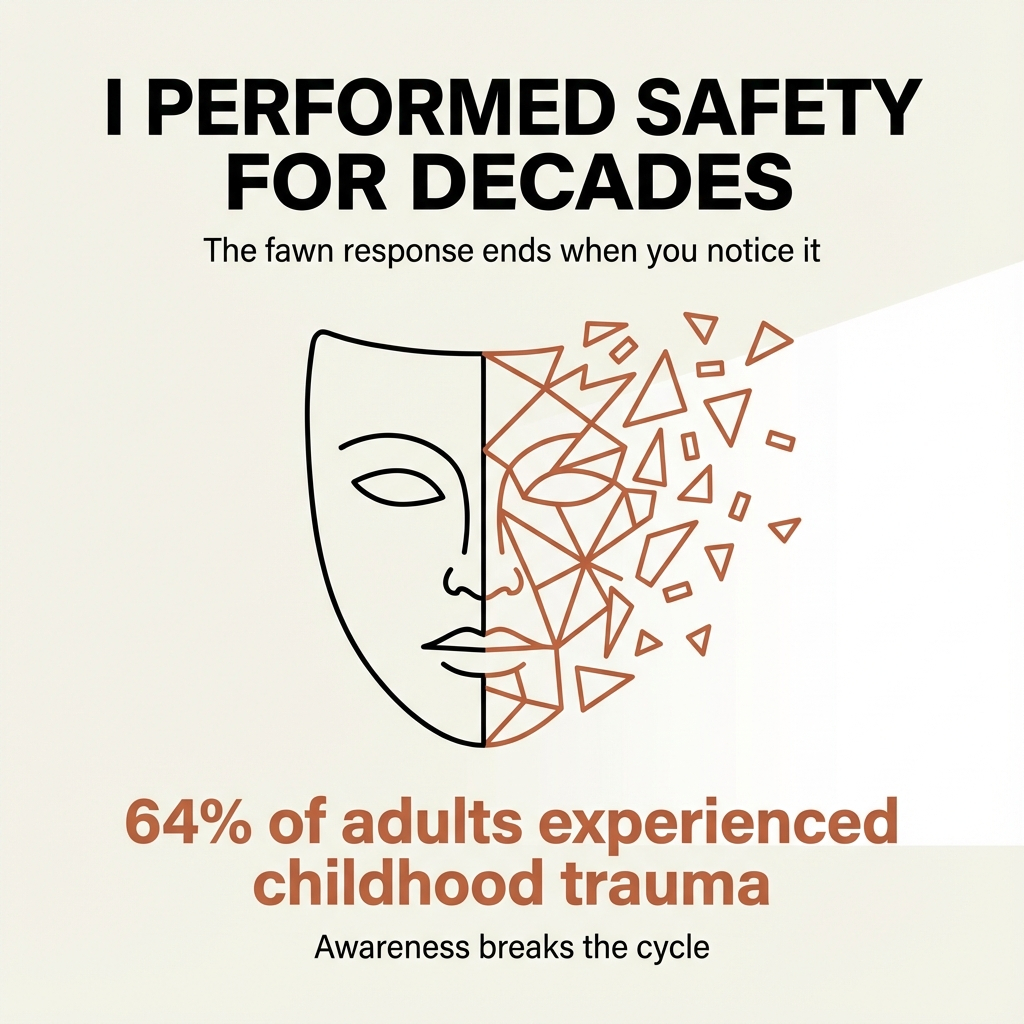
I spent decades performing safety.
Every yes I gave when I meant no. Every boundary I swallowed. Every time I made myself smaller so someone else would stay comfortable.
I thought I was being kind. Turns out I was trying to survive.
The fawn response does that. Your survival depends on staying likable, helpful, agreeable. Licensed psychotherapist Pete Walker coined this term in his book "Complex PTSD: From Surviving to Thriving," describing it as "a response to a threat by becoming more appealing to the threat."
Sometimes survival sounds like a yes when your soul is begging to say no.
Here's what I know now: About 64% of adults in the United States experienced at least one adverse childhood experience before they turned 18. Six studies show intergenerational transmission happens. Abuse or neglect in childhood often leads to adult perpetration.
Here's the part that matters: Awareness changes everything.
You break the cycle without becoming someone you don't recognize. You practice boundaries without turning into an asshole. You advocate for yourself while still being kind.
I'm going to show you how.
Why Fawns Stay Stuck in the Cycle
The fawn response emerges when you internalize that safety, love, or survival depends on appeasing others. Especially those who hold power over you.
In childhood, this happens because you learn to withhold your authentic emotions. You disconnect from your own feelings, sensations, and needs. You become so focused on reading the room and managing other people's reactions that you forget to ask what you want.
Research shows trauma reshapes personality traits. Emotional sensitivity increases. Agreeableness increases. Neuroticism increases. These traits create a perfect storm for fawning.
While fight and flight activate outward defenses, fawning turns inward. You try to avoid harm by becoming pleasing, helpful, agreeable. The logic says: If I stay likable enough, maybe I won't get hurt.
The problem? This pattern doesn't stop when the original threat disappears.
You carry it into your adult relationships. Your parenting. Your career. Your entire life becomes a performance of who you think people need you to be.
And then you have kids.
The cycle wants to continue. Not because you're a bad parent. Because trauma lives in your nervous system, and your nervous system doesn't know the difference between past danger and present safety.
Why This Matters: Fawning doesn't end when the threat leaves. Your nervous system keeps performing safety even when you're already safe.
What Do I Want? (The Most Revolutionary Question for Fawns)
What do I want?
This question is revolutionary for fawns.
You've spent years asking "What do they need?" You've become an expert at reading other people's emotions, anticipating their reactions, managing their comfort.
But when someone asks what you want, you freeze.
I remember the first time my therapist asked me that question. I stared at her. I had no idea. I'd spent so long performing that I'd lost track of my preferences, desires, boundaries.
Building awareness about your patterns gives you the power to do things differently. Parents who experienced trauma as children practice identifying their children's big emotions as age-appropriate reactions. You find ways to be supportive instead of reactive.
The first step is noticing. Noticing your patterns of fawning is progress toward overcoming them.
Pay attention to when you say yes but feel no. Notice when you're performing instead of being present. Watch for the moments when you abandon yourself to keep someone else comfortable.
Write it down. Track it. Get curious about it.
No judgment. Just observation.
The Breakthrough: Awareness gives you choice. You're not trying to stop fawning overnight. You're learning to see it so you have the power to choose differently.
The 5-Step Path From Performing Safety to Living Authentically
Step 1: Name the Pattern
You don't change what you don't acknowledge.
Start identifying your fawn response in real time. Notice when your body tenses up before you say yes. Pay attention to the feeling in your stomach when you're about to agree to something you don't want to do.
Practice this: When you feel that familiar pull to perform, pause. Say to yourself: "This is my fawn response. I'm safe right now."
The goal isn't to stop fawning immediately. The goal is to see it clearly.
The Shift: Naming the pattern gives you distance from it. You're not the fawn response. You're the person noticing it.
Step 2: Practice Small Nos
Setting boundaries is a skill. The more you practice, the easier it becomes.
Start with low-stakes situations. The friend who asks you to watch her kids. The coworker who wants you to cover his shift. The family member who expects you to host every holiday.
Say no to one small thing this week.
You don't need a long explanation. You don't need to justify your decision. You don't need to make the other person feel better about your boundary.
"I'm not able to do that" is a complete sentence.
Your nervous system will panic. That's normal. You've been trained to believe that saying no equals danger. Give yourself permission to feel uncomfortable while you practice anyway.
What This Builds: Each small no rewires your nervous system. You're teaching your body that safety doesn't require yes.
Step 3: Reconnect With Your Body
Fawning disconnects you from your physical sensations. You learn to override your body's signals because listening to them feels too dangerous.
You need to rebuild that connection.
Ask yourself throughout the day: What am I feeling right now? Where do I feel it in my body?
Tension in your shoulders. Tightness in your chest. Butterflies in your stomach. Clenched jaw.
These sensations are data. They're your body trying to tell you something.
When you notice discomfort, get curious. What boundary do I need right now? What am I trying to tell myself?
The Reconnection: Your body knows what you need before your mind does. Learning to listen is how you stop abandoning yourself.
Step 4: Build Your Support System
You don't break generational patterns alone.
Find people who understand what you're working through. A therapist who specializes in complex trauma. A support group for adult children of dysfunction. Friends who won't take it personally when you start practicing boundaries.
Survivors of intergenerational abuse who break the cycle are known as transitional characters. People who change the trajectory of their lineage because they refuse to let abuse reach the next generation.
You're doing hard work. You need people who see that and support it.
Your New Identity: You're a transitional character. The one who said "not on my watch." That's who you are now.
Step 5: Redefine What Safety Means
Healing begins when you learn that safety no longer requires self-erasure.
You're allowed to take up space. You're allowed to disappoint others. You're allowed to have boundaries and still be worthy of love.
This is the hardest part. Your nervous system has been wired to believe that your survival depends on staying small, quiet, agreeable.
You have to teach it something different.
Safety isn't about making everyone else comfortable. Safety is about honoring your own needs, expressing your authentic emotions, and trusting that you handle whatever comes next.
Practice reminding yourself: I am safe even when someone is disappointed in me. I am safe even when I say no. I am safe even when I prioritize myself.
The Redefinition: Safety used to mean disappearing. Now it means showing up as yourself and trusting you'll be okay.
What Breaking the Cycle Looks Like in Real Life
Breaking the trauma cycle doesn't mean you become perfect.
You'll still have moments when you fawn. You'll still say yes when you mean no. You'll still catch yourself performing instead of being present.
The difference is you'll notice it. You'll have the awareness to pause and choose differently next time.
You'll teach your kids that their emotions matter. That their boundaries are valid. That they don't have to earn love by disappearing.
You'll model what it looks like to advocate for yourself without apologizing. To be kind without abandoning your own needs. To take up space without feeling guilty about it.
Your intention to break the cycle is already a gift. To yourself. To your kids. To everyone who comes after you.
The Real Win: You're not aiming for perfection. You're aiming for awareness. That's what breaks the cycle.
When People Say You've Become "Difficult"
People will tell you that you've changed. That you're being difficult. That you're not as nice as you used to be.
They're right.
You're not performing anymore. You're not managing their emotions at the expense of your own. You're not making yourself small so they stay comfortable.
That feels different to them. They liked the version of you that didn't ask questions. That didn't have boundaries. That said yes.
You're not being difficult. You're being clear.
The people who care about you will adjust. They'll respect your boundaries. They'll appreciate the authentic version of you more than the performed version.
The people who don't? They were never safe for you anyway.
Permission Granted: Being called difficult means you're doing it right. You're no longer performing to keep others comfortable.
Your Next Right Step
You don't have to have it figured out.
You don't need a perfect plan. You don't need to know how this will unfold.
You need to take the next right step.
Maybe that's noticing your fawn response today. Maybe it's saying one small no this week. Maybe it's asking yourself "What do I want?" and waiting for an answer.
By becoming aware of your patterns and educating yourself about your behavior, you find freedom from people-pleasing and codependent behaviors.
The cycle stops with you. Not because you're perfect. Because you're paying attention.
That's enough.
You're enough.
You don't need anyone's approval to choose yourself.
The Truth: Breaking the cycle starts with one choice. You're making it right now.
Frequently Asked Questions About Breaking the Fawn Pattern
How do I know if I have a fawn response?
You say yes when you mean no. You feel responsible for other people's emotions. You struggle to state your preferences. You freeze when asked what you want. You feel guilty when you prioritize yourself. These are signs of fawning.
Will I lose relationships when I start setting boundaries?
Some relationships will change. People who benefited from your lack of boundaries might resist. But healthy relationships strengthen when both people have boundaries. The relationships you lose weren't serving you anyway.
How long does it take to stop fawning?
There's no timeline. Fawning is a nervous system response that developed over years. You're rewiring patterns, not flipping a switch. Focus on progress, not perfection. Noticing the pattern is already breaking it.
What if I become selfish or narcissistic?
Fawns worry about this because you've been trained to see self-advocacy as selfishness. Setting boundaries isn't narcissistic. Honoring your needs isn't selfish. You're balancing the scale, not tipping it the other way.
How do I practice saying no without feeling guilty?
Start with small nos in low-stakes situations. Notice the guilt without acting on it. Remind yourself that discomfort doesn't mean danger. Your nervous system needs repetition to learn that no is safe.
What if my family doesn't understand why I'm changing?
They might not understand because your fawning served them. You don't need their understanding to heal. You need your commitment to yourself. Find support outside your family while you practice your new patterns.
How do I teach my kids healthy boundaries when I'm still learning?
Model the learning process. Show them that adults make mistakes and grow. Tell them when you're practicing boundaries. Apologize when you slip into old patterns. They learn more from watching you try than watching you pretend to be perfect.
What's the difference between fawning and being kind?
Kindness comes from choice. Fawning comes from fear. Kindness honors both people's needs. Fawning abandons yours to manage theirs. Kindness feels genuine. Fawning feels like performing.
Key Takeaways
The fawn response makes you believe survival depends on staying likable, but awareness gives you the power to choose differently.
Breaking the cycle doesn't require perfection. You'll still have moments of fawning. The difference is you'll notice and choose differently next time.
Asking "What do I want?" is revolutionary for fawns who've spent years focused on everyone else's needs.
Practice boundaries in small, low-stakes situations first. Each small no rewires your nervous system to learn that safety doesn't require yes.
You're a transitional character. The one who said "not on my watch" to generational trauma. That's your new identity.
Being called difficult means you're no longer performing to keep others comfortable. You're being clear, not difficult.
Your intention to break the cycle is already a gift to yourself, your kids, and everyone who comes after you.


Comments
Post a Comment
We appreciate your comments!