Article by Lisa Loree - The Rebel Ballerina
Get Lisa’s eBook here: https://www.rebelfawn.com/ebook01 https://www.youtube.com/@RebelFawnMentoring
We call it being nice. We call it being considerate. We call it being a good person.
But what if that chronic people-pleasing isn't kindness at all?
What if it's actually our nervous system running on childhood survival programming, desperately trying to keep us safe in a world that taught us compliance equals survival?
This realization hit Lisa Loree like a freight train one year into her marriage. She'd moved halfway around the world with her husband, for his career. She was a professional ballerina who'd made it crystal clear she intended to keep dancing even after marriage and children.
Then came the ultimatum.
Her husband revealed his true intentions. She could return to the States to continue her career, but he wouldn't support her. Or she could stay with him and "continue this adventure."
Lisa stayed. She'd made vows. She was married. She was being loyal.
Except she wasn't.
She was being obedient.
Looking back from her perspective as a "recovering fawn survival type," Lisa now sees that pivotal moment differently. "I stayed when I absolutely should have left," she reflects. "And it nearly cost me my life."
The Obedience Programming
The difference between loyalty and obedience isn't semantic. It's neurological.
Lisa's obedience patterns started "waaay back when" with an emotionally absent father and also in the Christian church, where she learned a fundamental equation: obey without questions, and God will work out the rest.
Sound familiar?
This wasn't conscious decision-making. This was conditioning. "Do this because I said so. If you don't want to burn in hell, you will do what I say."
There's a checklist of how you're supposed to live. Severe consequences if you don't comply.
The result? A nervous system that learns: "Okay, okay, I'll do whatever I need to do, I'll do whatever you want."
Lisa makes a stunning comparison that most people would never consider. "It's almost like what a prisoner does in captivity. Even to the point of Stockholm Syndrome."
And that's exactly what childhood obedience conditioning creates.
The Neuroscience of Fawn Response
When fear and control dominate a child's environment, trauma response becomes inevitable.
Small children have no other means of protection. The consequence of not complying feels too great. So they comply.
But here's the crucial part: this happens at a subconscious level.
The child isn't thinking, "If I don't do this, I might be harmed or die or go to hell, so I better comply." We don't think like that.
Instead, there's a subconscious reading of the environment. A primitive assessment: This situation is dangerous. Compliance equals survival.
This creates real effects in the nervous system, building neurological synapses that wire compliance as safety. Over time, this builds what trauma psychology identifies as the fawn response.
We're not talking about personality traits here. We're talking about neurobiological survival mechanisms that become hardwired into our operating system.
Recognizing Fawn Response in Adult Life
So what does this look like when we're adults, running on childhood survival programming without even knowing it?
The telltale signs are everywhere:
People-pleasing that feels compulsive rather than chosen. You literally can't say no, even when saying yes hurts you.
Over-functioning for everyone else. You're doing so many things for other people that your own needs "aren't even on the back burner. They're not even in the kitchen."
Complete disconnection from your own voice. You can't think of yourself as important. Only everybody else counts.
Fear of being seen as selfish. If you think of yourself as important, you're being conceited and selfish.
The insidious part? Society applauds these behaviors.
Being kind IS a good thing. Being helpful IS a good thing. Being loyal IS a good thing.
But society falls short in one crucial area: understanding what's compelling that behavior.
Fear Masquerading as Love
This is where everything changes.
You have two completely different places these behaviors can come from. Genuinely, they come from love.
With fawns, they come from fear.
The same action. The same outward appearance. Completely different internal operating system.
When genuine kindness flows from love, it includes choice. You can say yes, and you can say no. You can help, and you can set boundaries. You can be generous, and you can prioritize your own needs.
When people-pleasing flows from fear, choice disappears. You're not choosing to be kind. You're compelled to comply because your nervous system believes your survival depends on it.
The difference isn't visible to others. But it's the difference between freedom and captivity.
The Stockholm Syndrome of Childhood
Lisa's comparison to Stockholm Syndrome isn't hyperbole. It's neuroscience.
Stockholm Syndrome occurs when captives develop positive feelings toward their captors as a survival mechanism. The captive's psyche recognizes that their survival depends on pleasing the person who controls them.
Now consider childhood environments where questioning authority brings severe consequences. Where compliance is demanded without explanation. Where a child's survival and belonging depend on suppressing their own needs and voice.
The parallel is exact.
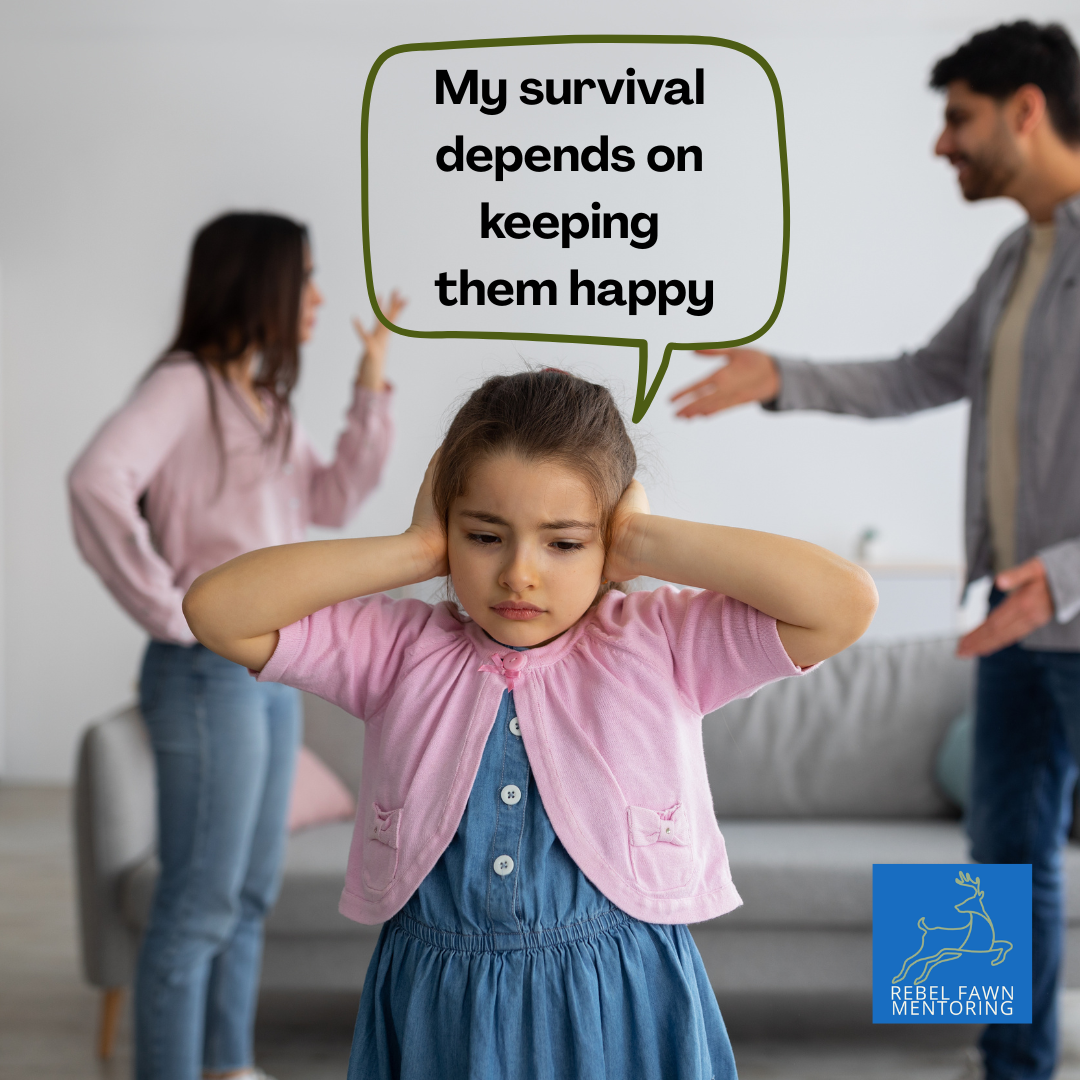
The child's developing nervous system learns the same lesson: My survival depends on keeping them happy.
This becomes so deeply embedded that decades later, as adults, we're still running on that same programming. Still believing, at a subconscious level, that our safety depends on everyone else's approval.
Breaking the Pattern
Recognition is the first step toward freedom.
If you're reading this and seeing yourself, you're not broken. You're not weak. You're not "too sensitive."
You're someone whose nervous system learned to survive in an environment that required compliance.
That survival mechanism served you then. It may be limiting you now.
The path forward isn't about becoming selfish or uncaring. It's about reclaiming choice in your responses.
It's about building what Lisa calls an "edge of protection." Boundaries that allow you to be genuinely kind without sacrificing yourself.
It's about learning to distinguish between love-motivated generosity and fear-driven compliance.
Most importantly, it's about understanding that taking care of yourself isn't selfish. It's necessary.
The Rebel's Path
Lisa calls her transformation journey "Rebel Fawn" for a reason.
Being a rebel, in this context, means something specific: taking care of yourself.
It means questioning the programming that says your needs don't matter. It means developing the capacity to say no without guilt. It means recognizing that your voice, your opinions, your dreams matter.
This isn't about becoming difficult or demanding. It's about becoming honest with yourself.
It's about operating from choice rather than compulsion. From love rather than fear.
The journey from fawn response to calm self-expression isn't easy. It requires rewiring decades of neural programming. It means facing the fear that kept you compliant for so long.
But on the other side of that fear lies something extraordinary: the life you were meant to live before survival programming took over.
A life where your kindness flows from genuine care rather than subconscious terror.
A life where you can be generous without sacrificing yourself.
A life where you finally have permission to matter.
That's not selfish. That's revolutionary.
And it starts with recognizing that your people-pleasing might not be kindness at all. It might be your nervous system's way of keeping you safe in a world that taught you compliance equals survival.
The question isn't whether you're kind enough. The question is whether you're free enough to choose when and how to express that kindness.
That choice changes everything.
Article by Lisa Loree - The Rebel Ballerina
Get Lisa’s eBook here: https://www.rebelfawn.com/ebook01 https://www.youtube.com/@RebelFawnMentoring


Comments
Post a Comment
We appreciate your comments!